Last week, the Santa Marta Conference on Transitioning Away from Fossil Fuels took place in Colombia, co-hosted by Colombia and the Netherlands. Below some background on how the conference came into being, its objective, main takeaways and how it complements the UNFCCC processes:
- The impetus to hold a conference on fossil fuel transition came from the failure to include the transition away from fossil fuel (TAFF) in any Belém negotiated text at last year’s COP. Over 30 years on from the first COP, states are still facing considerable difficulties in addressing the main driver behind climate change.
- At the onset of COP 30, President Lula voiced his ambition for the Brazilian COP to develop two roadmaps: one on TAFF and one on deforestation. Efforts to draft the TAFF roadmap in the context of the UNFCCC was thus an initiative led by the Brazilian COP Presidency to ensure discussions on the fossil fuel transition that were initiated by the Global Stocktake decision in 2018 continue.
- During COP 30, a large coalition of 80 countries advocated for a TAFF Roadmap to be adopted at COP 30 but the roadmap failed to be included in a decision due to strong opposition from other states.
- To ensure the TAFF remains under consideration, 24 countries supported the Belém Declaration on the Just Transition Away from Fossil Fuels, in which they pledged to work towards a just, orderly and equitable transition aligned with the 1.5°C temperature target. At the same time, the Netherlands and Colombia announced the organisation of the Santa Marta conference to discuss the TAFF.
- The transition away from fossil fuels is grounded in public international law and fully consistent with international legal obligations, as stressed last year by the International Court of Justice in its Advisory Opinion on the obligations of States in relation to climate change.
- The Santa Marta Conference gathered a “coalition of the willing” of 57 countries including major fossil fuel producers such as Canada, Norway, Australia, Nigeria, Angola, Mexico and Brazil (in total accounting for around one fifth of global fossil fuel production), in addition to 2,608 organisations and communities.
- Whilst the Conference took place outside of the UNFCCC process, it is complementary to it. The Conference formally contributes to the Presidency’s Roadmap on TAFF, all the while accelerating practical delivery, sending important political signals to drive action, and a shared understanding as well as actionable guidance for a TAFF that is just, orderly and equitable. The distinction between the Conference and the UNFCCC processes was also felt in the way the Conference was conducted: the format included breakout sessions and informal exchanges of views rather than negotiations.
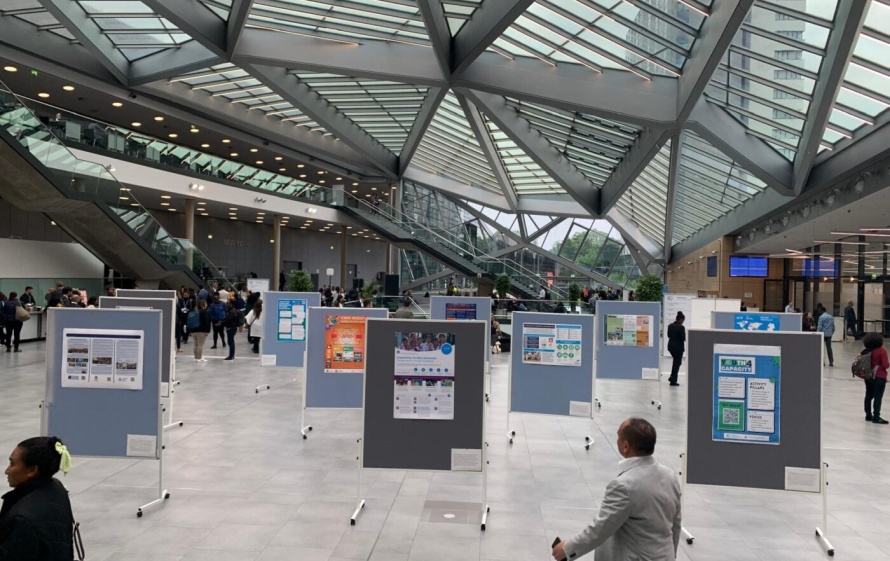
- The Conference comprised three thematic pillars: overcoming economic dependence; transforming supply and demand; and advancing international cooperation and climate diplomacy. The Conference started with an academic dialogue – in which the Science Panel for Global Energy Transition was established – followed by other stakeholder chapters as well as a People’s Assembly from 24-25 April. The Conference ended with the High-Level Segment of ministers and government representatives from 28-29 April.
- The outcome of the Conference identifies three workstreams, the contribution to which is voluntary. One concerns the development of national and regional TAFF roadmaps, which will be supported by the new Science Panel for Global Energy Transition and the NDC Partnership. The second work stream focuses on making the financial system compatible with the TAFF, tracking fossil fuel subsidies, and solving connected debt traps. The third workstream addresses fossil fuel-intensive trade.
- While such a process does not have the same authority and accountability as the UNFCCC process, the Santa Marta Conference was an important moment that squarely places the emphasis on implementation and science-based actions.
- Finally, the Conference demonstrated that implementation of the transition is not a one-off event but rather the start of a new multi-stakeholder process focussed on the implementation of the transition. To ensure this continuity, Tuvalu and Ireland will be co-hosting the second conference on Transitioning Away from Fossil Fuels in 2027. It will be interesting to see if the invitation is extended to a larger group of countries, including top emitters such as China, Russia and the US.
- For more information on the development of the COP 30 Presidency’s roadmaps on fossil fuel and deforestation, please see our summary section on this topic.