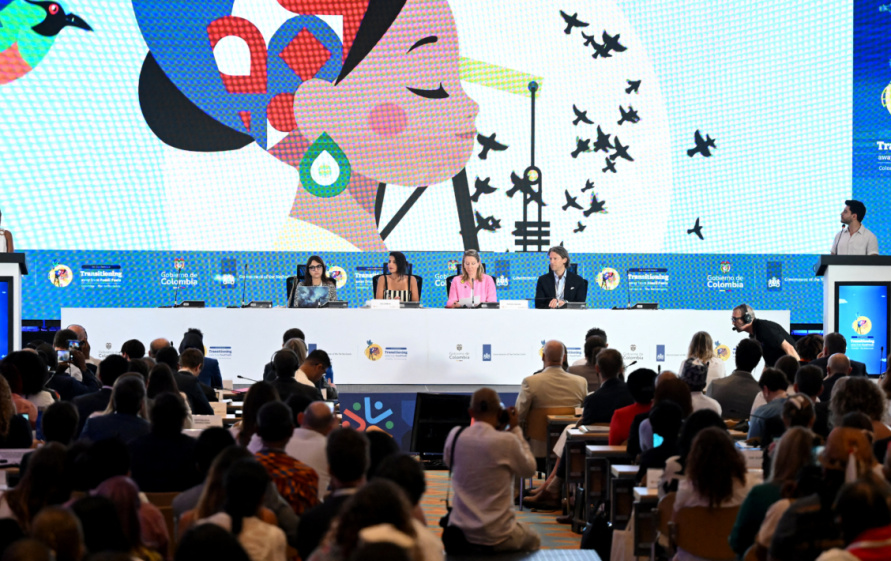
Türkiye and Australia have reached an unprecedented compromise to jointly host the 2026 United Nations Climate Change Conference (UNFCCC), “COP 31”.[1] [2]
Under the practice of regional rotation within the UNFCCC Conference of the Parties (COP), the host country of the COP normally rotates among the five United Nations regional groups. As such, the 2026 summit fell to the Western European and Others group that includes Australia and Türkiye. It is up to each regional group to nominate a host by consensus. However, in the run-up to COP 31, a deadlock emerged as both countries heavily campaigned for their own bids.
Australia pushed to host the summit in Adelaide, with the intention of co-hosting alongside the Pacific Island states to highlight their vulnerability to rising sea levels and climate change. In contrast, Türkiye proposed hosting the event in Antalya, arguing it had a rightful claim after stepping aside in 2021 to allow the United Kingdom to host the Glasgow summit.[3] This unusual compromise raises an important procedural question: can the functions of the COP presidency under the Draft Rules of Procedure of the Conference of the Parties effectively be divided between two states?
Neither country was willing to concede. If they failed to reach a consensus, the UNFCCC rules of procedure would have defaulted the COP 31 location to Bonn, Germany, the UNFCCC’s headquarters.[4] Australia’s climate minister, Chris Bowen, noted that defaulting to Bonn would have meant 12 months without a dedicated COP president or clear preparatory plan, which he described as “irresponsible for multilateralism.” To avoid this outcome, a unique compromise was brokered during the COP 30 summit in Brazil, splitting the core summit responsibilities between two nations. Although this is not the first time that there has been a split of responsibilities: for instance COP 23 was presided over by Fiji but hosted in Bonn, Germany and COP 25 was presided over by Chile, but hosted in Madrid, Spain, the arrangement represents a significant new step as it is not only the logistical aspects of hosting the conference which have been divided, but the specific roles and responsibilities of the Presidency.
A novel institutional compromise
As established both through the UNFCCC rules of procedure and usual practice, including the Presiding Officers’ Guide,[5] the role of the President of the Conference of the Parties traditionally involves overseeing the formal proceedings of the summit, ensuring that the rules of procedure are followed, and guiding negotiations toward consensus. They work closely with the UNFCCC secretariat and Bureau to shape provisional agendas, while engaging with Parties in the year running up to the COP on key issues. The President declares the opening and closing of sessions, presides over meetings, regulates the debate, and oversees the voting and adoption of decisions. They work directly with country delegations to facilitate agreement on key issues and is often tasked with raising global ambition to tackle climate change. The President must remain neutral, acting under the authority of the Conference of the Parties rather than as a representative of their own country.
Generally, the President of the COP is nominated by the host country. However, there have been occasions where this has not been the case. For instance, at COP 23, Fiji held the COP presidency while the conference itself was hosted at the UNFCCC secretariat headquarters in Bonn, with logistical support from the German government. This arrangement separated the COP presidency from the physical host location due to practical constraints, including infrastructure limitations in Fiji. Likewise, at COP 25, Chile held the COP Presidency, but due to intense civil unrest and socio-political instability the conference was held in Madrid, Spain. In both instances, the Presidency was held by a single country, regardless of support from the host.
However, the COP 31 compromise differs in that it did not arise due to logistical constraints preventing the hosting of the conference in the country holding the presidency; the division of responsibilities arose out of an agreement between the two countries to co-Preside the conference, sharing both logistical and outcome-related roles and responsibilities.
According to the COP 31 Partnership Modalities, Türkiye, which has nominated His Excellency Mr Murat Kurum as President-Designate of COP 31/CMA 8/CMP 21 to be elected as COP 31 President at the beginning of the conference, will serve as the physical host country for the main event in Antalya, entering into the Host Country Agreement, managing logistics, schedules, and operations. The COP 31 President will “act based on the Draft Rules of Procedures of the UNFCCC”,[6] including the opening and closing of the session, overseeing the adoption of decisions (including their gavelling and determining that consensus has been reached) and ruling on points of order. Türkiye has also appointed Mr Samed Ağırbaş as the UN High-Level Climate Champion to oversee the delivery-focused “Action Agenda”, a voluntary, non-negotiated, outcome-oriented track designed to accelerate implementation.
Australia, meanwhile, will lead the bulk of the political and substantive direction of the summit. Australia’s climate minister, Chris Bowen, will serve as the newly created ‘COP president of Negotiations’ and will steer the formal negotiation process. He will be assigned by the COP 31 President-Designate, and will be delegated the functions of leading the COP 31 negotiations over which he will have “exclusive authority”. Through this exclusive delegation, the COP 31 President’s powers will be limited to take on any tasks which have been exclusively delegated. In theory, the COP 31 President will not be able to relinquish this delegation of powers, granting a wide set of powers to Chris Bowen.
As part of these exclusively delegated powers, the COP 31 President of Negotiations, will convene consultations and meetings throughout the year as needed to inform negotiations and prepare communications related to the negotiations. He will also select ministerial and other co-facilitators to advance discussions and take forward relevant mandates arising from negotiated outcomes. Chris Bowen will also be responsible for producing draft texts and will engage with the UNFCCC regarding the negotiations.
As a result, under this novel compromise, the Turkish Presidency retains the authority associated with the office under the UNFCCC Rules of Procedure as well as stewardship of the Action Agenda. Australia, by contrast, is entrusted with the substantive political and technical leadership of the negotiations.
The pre-COP meeting as a strategic extension of the Presidency
For COP 31, Australia had originally campaigned to co-host the summit alongside the Pacific Island states to highlight their vulnerability to rising sea levels. As part of the compromise, it was decided to hold the pre-COP meeting on a Pacific island. The pre-COP meeting is an informal but traditional preparatory meeting held in the lead-up to the main conference. It plays an important strategic role by allowing Parties to build consensus, outline priorities, and narrow specific regional or thematic issues before the formal negotiations commence. It also favours public participation, thereby highlighting the strategic value of hosting the pre-COP.
Australia, in partnership with Pacific Island countries, will set the agenda and preside over this meeting, as well as fulfil all operational and logistical responsibilities for the pre-COP. Chris Bowen announced that Fiji will serve as the primary host, alongside an associated leaders’ component in Tuvalu and a special climate event in Palau.[7] The meeting will serve as a strategic opportunity to elevate their regional priorities, such as addressing the climate finance gap for mitigation and adaptation, within the broader COP process. Thus, the pre-COP will hopefully ensure Pacific issues remain “front and centre”.[8]
The importance of the agreement
According to the UNFCCC draft rules of procedure, the COP President remains in office until their successor is elected at the start of the next ordinary session.[9] Because Türkiye holds the formal COP 31 presidency, its appointed official will hold office until the COP 32 summit begins. Although the bulk of the work takes place in the lead up to the summit and concludes at its close, the COP President plays an important role as a mediator to ensure the implementation of agreed deals and advances discussions during intersessional negotiations, while also working with the incoming presidency to ensure that there is continuity.
Since the COP 31 arrangement involves splitting the core responsibilities of a single presidency simultaneously between two nations, the shared leadership model could inadvertently dilute climate ambition and hinder the smooth transition to the COP 32 presidency. Because the role of President of Negotiations does not formally exist within the UNFCCC Draft Rules of Procedure, it remains unclear what institutional authority this position will retain once the summit concludes.
Ambiguity over leadership roles could lead to gridlock or dilute climate ambition if disagreements emerge between the two leadership teams. Questions remain about whether Türkiye will have the final word, given that they have granted exclusive authority in relation to the negotiations to the COP 31 President of Negotiations from Australia. Questions also remain on Australia’s role while Türkiye holds office until the beginning of COP 32. The consultations which will take place to resolve the matter to “mutual satisfaction” incur the risk of slowing negotiations.
In addition, Türkiye secured its position by refusing to step aside despite Australia initially receiving support from the majority of its regional group. Some experts warn that this outcome could encourage future candidates to hold consensus decision-making hostage more widely in order to secure private concessions,[10] potentially undermining the efficiency and cooperative spirit of the UN climate process. This development further highlights growing concerns about the consensus decision-making process within the UNFCC.[11] Managing relations with two leadership states rather than one may also place additional diplomatic and administrative burdens on delegations, particularly those from developing countries with limited negotiating resources.
Nevertheless, separating the duties of shepherding nearly 200 parties while simultaneously hosting a massive global event could allow both the Turkish and Australian Presidency teams to focus more fully on their responsibilities, potentially strengthening both the negotiation process and the organisational management of the summit.
The model may also expand opportunities for small or vulnerable states to exercise leadership within the COP process. Many Pacific Small Island Developing States lack the infrastructure required to physically host a summit of this scale. A more flexible leadership model could enable such states to take on prominent negotiating roles without bearing the logistical burden of hosting the event itself.
Testing the Limits of UNFCCC Institutional Flexibility
Whether the role and functions of the COP President can be effectively divided between two states remains to be seen. Ultimately, the Türkiye–Australia compromise represents a pragmatic response to a political deadlock, but it also tests the institutional flexibility of the UNFCCC framework. Its success or failure will signal whether multilateral climate governance can adapt to more complex forms of shared leadership as geopolitical tensions increase and the demands of global climate cooperation continue to grow.